Concrete Retaining Walls in El Paso TX - a wall that drains and stays upright
Dirt washing off the slope or an old wall leaning out? We build a concrete wall that holds the ground and lets the water out.
- Licensed and fully insured.
- Free on-site estimates.
- We respond within 1 business day.
What goes into a concrete retaining wall in El Paso?
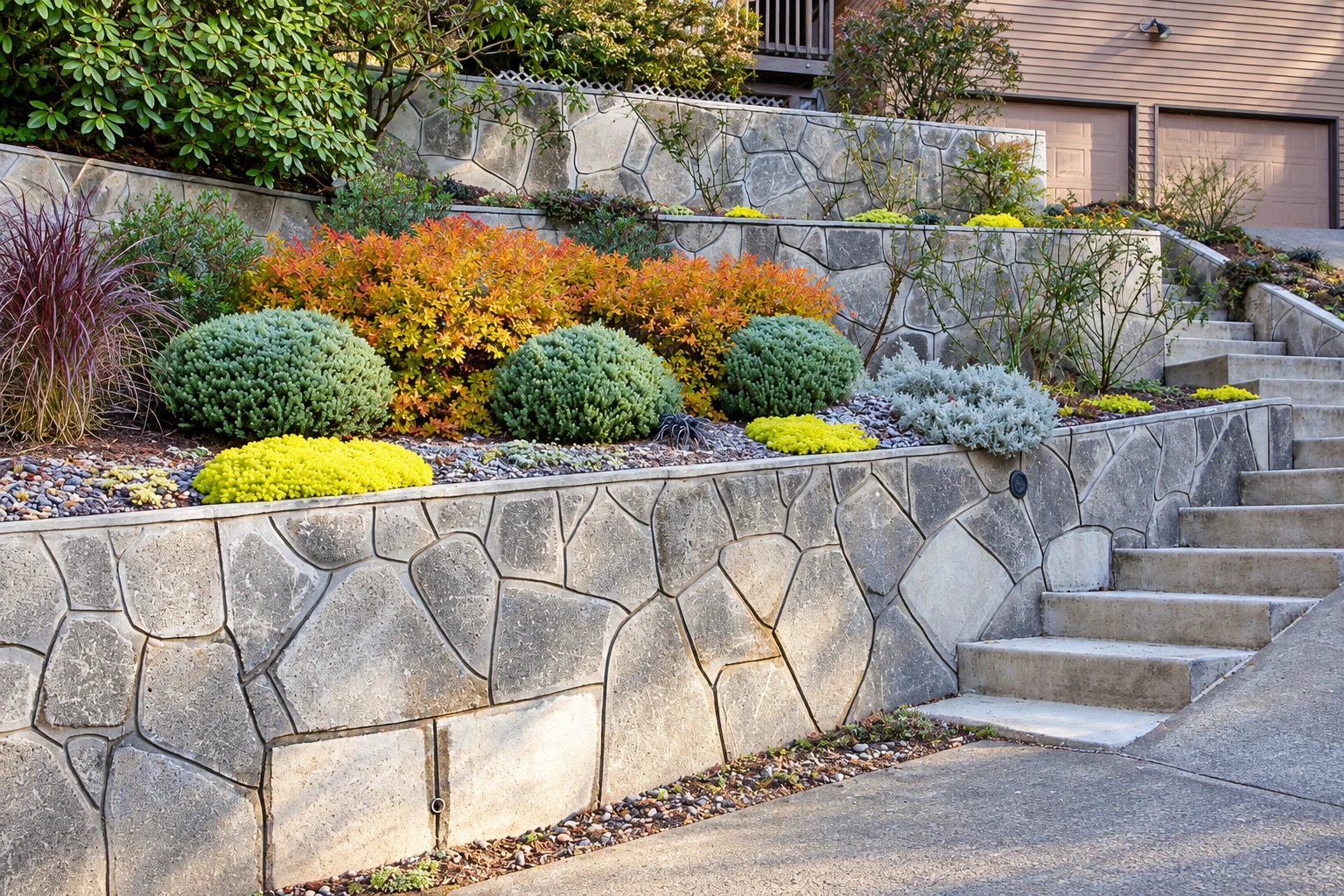
A concrete retaining wall holds back a slope so you get flat, usable ground, and at Formcraft El Paso Concrete Company we build them across El Paso, TX on a concrete footing that keeps the wall from tipping over or sliding.
Most calls start with a back yard that sheds dirt onto the patio every time it rains, a slope crowding the house, or an old wall that's started to lean. The price moves with the wall's height and length, how much digging and drainage it needs, whether an old wall has to come out first, and how easily a concrete truck and machines can reach the spot. The schedule turns on any paperwork the job needs and the weather on pour day. I'll measure it and give you your own number in a written estimate, and if you need a way up the slope, we can build concrete steps into the same job.
How do you know your slope or wall needs work?
Wall leaning toward the yard
The top of the wall tips out past the bottom, which usually means water or loose ground under the footing is winning. A lean only grows, and when the wall finally goes it brings the slope down with it onto your fence, patio or walkway.
Wet streaks at the base
Dark stains or mud seep through cracks and joints instead of draining out at the bottom, which means water is trapped behind the wall with no way out. Every storm adds pressure, and fixing the drainage while the wall still stands costs less than rebuilding it.
Dirt washing into the yard
There's no wall yet, and every hard rain moves soil onto the walkway or up against the house. The slope keeps creeping, so waiting means more cleanup each time and more dirt piled where it can hold water against your walls.

How we build a concrete retaining wall
A wall gets pushed over by the water behind it more than by the dirt, so before we dig, I work out where that water will get out. We dig the footing down to firm, undisturbed ground or packed fill, because the footing is what holds the wall in place and loose dirt under it settles. Then we set rebar, the steel that takes the soil's push, pour the footing and build the wall with weep holes, small openings low in the wall that let water through, plus a drain pipe along the back on taller walls. Behind it goes fill that drains, not whatever came out of the hole.
A wall usually makes flat ground for something else. If cutting into a slope makes room for a shop or storage building, our concrete floor installation crew pours that slab on the level ground the wall leaves. When the flat ground is for a pool, we plan the wall and the concrete pool deck together, so water off the deck and water off the slope don't end up in the same place.
Poured concrete wall
Concrete poured into forms around steel, so the wall goes up as one solid piece. It suits walls that hold up a driveway or a yard you'll use hard, and you get a smooth face you can leave plain.
Reinforced block wall
Concrete block with steel set upright in the hollow cores, then filled with concrete. It suits garden and terrace walls, and it's often the easier choice where a concrete truck can't get close.
Get a written price for your retaining wall
We reply within one business day to set a time, and I come out to measure the slope for a free on-site estimate. There's no obligation, so you can hold it up against other bids.
- Based in
- El Paso, TX 79901
- Hours
- Mon–Fri: 8 AM–10 PM, Sat–Sun: 6 AM–9 PM
What happens after you call about a retaining wall?
Here's how a wall goes from your first call to fill back in behind it, and who you deal with at each step.
I come out and measure
I look at the slope, measure where the wall will run and ask what you want the flat ground for. Notice where the water runs off now, because that shapes the drainage plan.
You get a written estimate
It lists what's included and what isn't, from the footing and drainage to hauling dirt away, so you can line it up against other bids. If one bid is a lot cheaper, check what it leaves out.
We handle prep and forms
We line up any paperwork the job needs, dig out, and set the forms and steel. You'll see the drain pipe and weep holes go in before anything gets covered.
We pour, backfill and clean up
We pour when conditions make sense, not on a schedule that fights the heat. When the wall is ready, the draining fill goes in behind it and we clean up the site.
Why El Paso homeowners call Formcraft El Paso Concrete Company about a wall
The owner writes your estimate
I come out, look at the slope and write the estimate myself, and I'm on site the day we pour. Our own crew does the work, so the person who planned the drainage is watching it go in.
Thirteen years pouring concrete
I framed houses for years, then learned concrete under a finisher here in El Paso and started this business in 2013. Framing taught me what happens to anything built on ground that wasn't ready.
Proof of insurance before we dig
We're licensed and fully insured. Ask to see it when I come out, since a wall job means digging and heavy equipment near your house and your neighbor's fence.
No promises concrete can't keep
I won't tell you a wall will never crack, and I'd rather lose the job than promise it. What we do is get the base and the drainage right, and the work is backed by our satisfaction guarantee.
If you're comparing bids, ask each one where the water goes and what goes behind the wall. When you're ready, send us the details or call (915) 265-1446.
Retaining walls, drainage and permits in El Paso
The City of El Paso requires a permit to build, alter, repair or tear down a building or structure, and its One Stop Shop takes building permits. That rule is written in general terms, so whether your wall needs one is something we check with the office for your address before we dig. When a job calls for a permit, we handle the paperwork with whichever office covers your address, whether that's a city, the county or the state in New Mexico.
On jobs here we see a lot of back yards cut into a slope and old walls along the property line that were stacked up with no way for water to get out. When one of those is leaning, we usually take it out and start over on a proper footing rather than prop it up, and we see the same walls on jobs in Sunland Park and Horizon City.
Questions about retaining walls in El Paso
How much does a concrete retaining wall cost in El Paso, TX?
A poured concrete retaining wall in El Paso usually costs about $33 to $35 per square foot, installed with labor. That usual range leaves out walls taller than 3 feet and yards with difficult soil, and it doesn't cover tearing out an old wall, stamped or multi-colored concrete, curved walls or brick. If your job has any of those, expect your estimate to land somewhere else.
Why does a retaining wall need drainage behind it?
Drainage lets water escape through weep holes, and on taller walls a pipe, before it builds pressure behind the wall. Clay or topsoil packed straight behind a wall is the fastest way to ruin that, because clay holds water, swells and presses harder against the wall than gravel does.
How do I check the drainage on my retaining wall?
Walk the wall after a heavy rain and make sure water is coming out of the weep holes and the pipe outlet. A drainage system works for years with little attention, but it's worth that check about twice a year.
How long does it take to build a concrete retaining wall?
It turns mostly on the wall's length and height, any paperwork and the weather on pour day, and I can give you a better idea once I've seen the site. The part people don't expect is the wait after the pour, because the soil shouldn't go back behind a new wall until it has gained enough strength or been braced.
How close can a skid steer get to a new retaining wall?
While the fill goes in, heavy equipment should stay back from the top of the wall by at least the wall's own height. That's worth knowing early in a tight yard, because it decides where machines can work and how much gets moved by hand.
Will a new concrete retaining wall crack?
It may get hairline cracks, because concrete shrinks as it cures, and nobody can honestly promise a wall that never cracks. The cracks that matter come from a weak base or trapped water, so that's where we put the work.
Other concrete work that goes with a retaining wall
Concrete floor installation
When a wall cuts into a slope to make room for a shop or storage building, we pour the floor slab on the level ground it leaves.
Concrete pool decks
If the wall levels your yard for a pool, plan the deck at the same time so it sheds water away from the wall and the house.
Areas we serve for retaining walls around El Paso
Formcraft El Paso Concrete Company is based in El Paso, TX, and we build retaining walls across the city and the cities around it, in Texas and over the line in New Mexico. Below are 12 areas with their own page, including Socorro and Canutillo.
El Paso, TX
Tell us about your slope and wall
Have the wall's rough length and height, a few photos of the slope and details of any old wall ready, and I can talk it through with you on the first call.